Header Link Map

Image Map
Showing posts with label ag Q&A. Show all posts

Wednesday, September 28, 2016

How Long Does it Take to Plant and Harvest Your Crops?

This is definitely a question that I've heard before.  Growing up on a farm, I guess I never gave it much thought.  How long does it take to plant and harvest your crops?

There really isn't a definite answer to this question.  While I can say how long it typically lasts on our farm, it depends on location and how many acres one farms.  Planting usually starts the end of April/beginning of May here in southeastern Indiana.  Several things are taken in to factor when deciding when is the right time to begin planting.  I devoted a whole post to this topic actually, so if you are really interested in learning be sure to check it out here:).

Planting for us typically lasts 2-3 weeks depending on good ole Mother Nature.  Sometimes it takes longer.  Of course there is a lot of "prep" work that goes into planting too, like spraying the ground to help control weeds early.  We call this spraying burndown.  Also, we apply Anhydrous Ammonia to our fields that will be planted to corn.  We do this before the field is planted.  Some farmers do it after the corn is planted.  This is called side dressing.

Below, Brad is applying Anhydrous Ammonia to a field that will later be planted to corn.  This picture was taken mid-April of this year.


Harvest for us typically lasts A LOT longer.  Notice how I capitalized the A LOT part?  At least we hope it lasts long because that means yields are good....hopefully.  2012 didn't last very long, but it seemed like it lasted way too long.  That was the year of the drought and yields hit an all time low, but we don't like to talk about that!
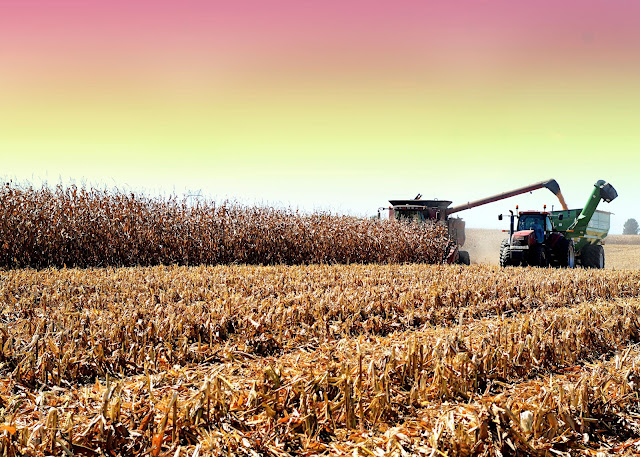
How long does planting and harvest last on a farm?


Harvest for us will last about 5-7 weeks, again, depending on Mother Nature and everything working like it is supposed to.  All the grain that comes off the farm has to be hauled either to our farm for storage, or to a grain elevator to be sold.  All of this takes time that's why it is important to be efficient on the farm.

How long does planting and harvest last on a farm?
The grain cart, or auger cart as some people call it, in the picture above will be pulled along side the combine for the combine to unload the corn on to, so the combine only has to make minimal stops.  If the combine had to stop at the end of each round to dump on a wagon or semi, a lot of time is lost.

How long does planting and harvest last on a farm?
We started harvesting on September 20th.  Our goal...or my goal rather:)...is to be done by Halloween, so we will see.  In past years it has started much later and we don't finish until around Thanksgiving.
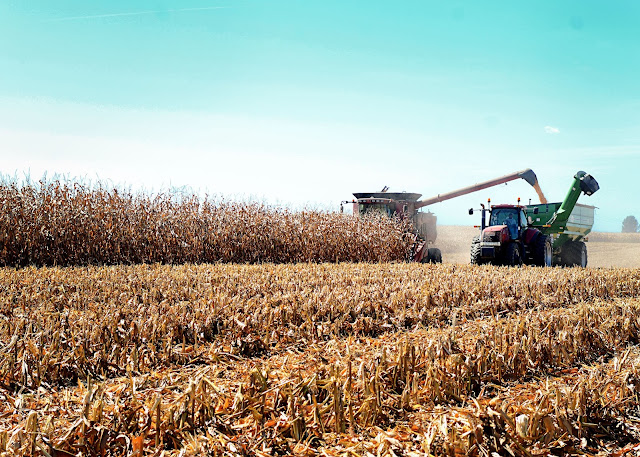
How long does planting and harvest last on a farm?
Planting seems to go by fairly quick, but sometimes harvest seems to drag on forever...I'm saying this from a farmwives perspective.:)

Farmers work in acres, not hours www.titanoutletstore.com:

Our meals around the kitchen table are usually replaced by meals in the fields.  I am becoming a pro at tackling kids' activities and busy schedules by myself.  It definitely takes a village to raise kids, and I'm thankful for my village of family and friends who are willing to help out.  I've gotten used to asking for help.  Something I thought I'd never be able to do!  While this time of year can be a struggle, I'm thankful that the rest of the year allows my husband to attend a lot of their activities.  

While sometimes it's hard, I couldn't imagine living or raising my kids anywhere else!

"It isn't the farm that makes the farmer, it's the love, hard work, and character." ~ Unknown #farmquotes #agriquotes:

And when Harvest is over,....
Pretty relatable today!! #ILCorn:

:) Wishing you all a safe harvest season!!!


How long does planting and harvest last on a farm?


Photobucket

Thursday, September 1, 2016

What is Chopping Silage and Why Do You Leave Corn Standing in the Field...

These are two questions that I often hear.  People also want to know why we just let our crops die in the field.  I wrote a whole post on that topic and you can check it out here.  When we chop silage, we chop it when it is still green because we want there to be some moisture left in the plant.


When we let the corn dry in the field for harvest, we only want the corn kernels.  The combine separates everything else and spreads it back on the ground like in the picture below.  This will break down over the winter and add nutrients back into the soil.

But, around Labor Day we begin chopping silage.  It may be earlier or later depending on the weather.  We chopped this past week and are finishing up custom chopping today.


Basically everything gets used from the corn plant when we chop silage.  It creates on big salad for the cattle and they love it.  The chopper chops the corn and it is blown onto a wagon being pulled by a tractor beside it.


I grew up on a dairy farm where we chopped a lot of silage each year.  It seemed to go on for weeks, but really it was only a few days.  The whole process amazes me.  I don't know why exactly.  Maybe I just like seeing so much action on the farm at one time?  I don't know, but this might be my favorite time on the farm.  And the smell of silage is amazing;).


Hitching a ride with Dad..


We put the silage into a bag to keep it nice and fresh all year long.  I like to think of chopping silage like canning veggies from your garden.  You want to make sure you have enough to last all year and make sure it stays fresh.  The tractor pulls up beside the bagger...

Then the silage is pulled from the wagons by conveyor...

and sent over to the bagger by way of another conveyor.
This is what the system looks like from the front...


And this is from the back.  As the silage fills the bag, the tractor attatched to the blue and green bagger automatically pulls up a few inches and the process continues until the bag is full.  We fill two bags each year.


So, why don't we chop all of our corn?  Why do we leave some in the fields?  


Don't worry, we won't forget about it and leave it in the field!  We only chop enough to feed our cattle for the year.  The rest will be left in the field to continue drying down and will be harvested by the combine later this fall.  We will store some of that in the grain bins and use for feed as well, but he rest will go the grain elevator to be sold.

what is chopping silage?


Photobucket

Friday, July 1, 2016

How Do You Eat the Animals You Raise?

How do you eat the animals you raise?  This is a question I hear often, especially this time of year.  We just finished our county fair last week.  Our girls show pigs, dairy cows, and also do drawing, sewing, and woodworking.  While I love all aspects of the fair, the livestock portion is probably my favorite because it allows the general public to get an up close look at livestock from a farm.  A couple people asked me this question just last week, so I thought it would be the perfect time to write a post on the topic!

Below is a picture of our oldest, B showing one of her pigs at the fair.

The first thing our kids do when they get their 4H animals is name them.  These animals are washed regularly and also brushed daily for about a month leading up to fair.  They are also walked in preparation for the show ring.  Walking is a form of exercise for the pigs.  Our girls spend A LOT of time with their 4H animals, just like all the other 4Hers out there.

To say that they get attached to these animals is a HUGE understatement.  After the fair, when it's time to say goodbye to their pigs there are usually many tears shed, BUT our girls also know that is how the food cycle works and with watery eyes, they look forward to next year when they get new pigs.

We have always been up front with our girls about where their food comes from.  They live and breathe farm life every day and I feel it is important for them to know.  That being said, we do not "eat" our 4H animals per say.  Our girls know where they go from the fair, but they don't end up in our freezer.  Some people do this, but I just know it would be too hard on the girls.

We do have a beef processed from our farm yearly for our own personal freezer.  Our girls know that these beef cattle come from our farm, but like I said before, they know this is the circle of life.


The girls participated in the Summer Reading Program at our local library this summer.  The theme was Hoosier Quest and since Indiana is celebrating it's 200th birthday this year, it was all about the history of our state.  At the first program there was a magician that came and acted as if he was from the 1800s.  Somehow the subject was brought up about cattle and hamburgers and a little boy said something about not eating cows.  The magician said, "Well, do you like to eat hamburgers?" To which the little boy replied, "Yes."  The magician cleared that up rather quickly.  I understand that it can be difficult for some people to understand, but this is our livelihood and this is what we do.  The beef cattle on our farm are cared for daily and are fed the perfect ration of feed.  They are checked daily to make sure they aren't sick, and they always have clean water and bedding, but we try no to get too attached.


Below are some pictures of the girls (and your's truly:)) showing their dairy heifers/cows.  A heifer means they haven't had a calf yet.

B and her calf, April...


 After the fair, they will bring their dairy calves, heifers, and cows back home, unlike the pigs. The hiefers will remain on our farm until a few months before they calve, then they will go to a neighboring Amish farm who has a dairy, where he will take care of them and ensure they have the proper care.  There is a big difference in the equipment needs for dairy and beef cattle and we aren't set up to handle dairy cows, but luckily they are just down the road, so we visit them often.

B and Peyton.  Peyton is a 3 year old cow who just had her first calf in April....which is the April that B is showing in the picture above.

Mel with her calf, Judy, and B with April...
And here is a picture with me in it and it appears B is telling me what to do in the show ring:)  I am leading Mel's 3 year old heifer, Elsa.  She is expecting her first calf in December.


Some people may judge, but for us it is a way of life.  All of our animals are cared for and loved, it's just harder to say goodbye to some;)


Photobucket

Thursday, March 31, 2016

Do You Have Cows?

When someone asks what type of farm we live on I always rattle off, "corn, soybeans, and beef cattle."  Then they usually ask, "Do you have cows?"


The answer is, no.  We have a feeder calf operation which means, so we don't have cows.  We buy our calves from another farmer (who has cows and calves) when they are about 600 pounds or about 6 months old.   We then feed them out for about another year until they reach market weight, which is about 1200 pounds.  I explain what exactly we feed our calves in this post.


Several years ago (before I was in the picture;)) my husband's family had cows and calves on pasture.  For economical reasons, that pasture has since been turned into farm land.  For several years, we didn't have any cattle, but my husband loooves taking care of cattle, so we bought some and eventually our herd tripled in size.


At one time, we can have about 200 head of cattle that we are feeding.  My friend Marybeth at Alarm Clock Wars does have cows and calves.  She and her husband John She recently wrote this post on Alarm Clock Wars that talks about how old their cows really are.

Like I said above, my husband absolutely loves to feed cattle.  His passion is farming and raising good quality cattle that produce good, quality meat, so the next time you enjoy a juicy steak or cheeseburger at your favorite steak restaurant, it very well could have come from our farm.


Photobucket

Web Statistics